Monday, May 13. 2013
Printer Friendly
Now that PostgreSQL 9.3 beta1 has been released we've started to jump start our experimentation by compiling our favorite extensions. First on the list is PL/V8 js.
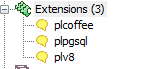
This was compiled against 9.3beta1 for 64-bit and 32-bit and plv8 version 1.4.0. We briefly tried with the EDB windows builds which we downloaded from: http://www.enterprisedb.com/products-services-training/pgbindownload and seems to work fine.
We hope windows users find these useful.
Thursday, December 13. 2012
Printer Friendly
As Hitoshi Hirada mentioned already in PL/v8 is now the richest procedural language , PL/V8 1.3 has been recently released and some of the great new features are automatic conversion of json objects, and ability to write window functions. Not only does PL/V8 allow you to make the most of the native JSON support in PostgreSQL 9.2, but in many cases particularly numeric processing, the speed is much better than what you get with plpgsql. Someone asked us a while back about this and we are hoping to do a demonstration of pl/v8 for numeric processing where you can see the marked difference in speed and perhaps compare with something like PL/R that is also often used for array numeric processing.
For those who are on windows we've compiled PLv8 1.3 for windows 32-bit and windows 64-bit that work with PostgreSQL EDB installs. We haven't had a chance to thoroughly test them yet, so let us know if you find issues. We've saved the last versions we compiled under a different name since some things are not backward compatible between the PLv8 1.1 and 1.3 releases.
We are also hoping to making our windows binary download links more visible. For stop gap fix, we are tagging all the articles concerning things like FDW extensions, PostGIS, plv8 we've compiled for windows under winextensions and accessible from http://www.postgresonline.com/winextensions.php
Continue reading "PLV8 1.3 windows binaries for PostgreSQL 9.2"
Sunday, September 23. 2012
Printer Friendly
Unfortunately we missed Postgres Open this year, but we did catch some of the slides. One of them was Embracing the web with JSON and PLV8 by Will Leinweber of Heroku. He had a great slide deck with a lot of interesting points. One surprising for us was that even in tasks that both PL/PgSQL and PL/V8 can do, PL/V8 is sometimes faster as demonstrated in his slides:
#51 thru #54
Another interesting point he covered which is the topic of this article is the ease with which you can build PLV8 functions from javascript libs on the web. In particular JSON:Select library.
In one article we demonstrated a JQuery app with PLV8 and one of JQuery's foundations is the CSS like selector syntax it provides for JSON and HTML document elements which allows you to drill down a document using CSS3 style referencing, much like what xpath does for xml. One of the glaring features missing in PostgreSQL 9.2 basic JSON support is a function to navigate a JSON document comparable to the PostgreSQL built-in xpath function for xml.
So how do we get this json selector goodness available to us in the database? Like all good monkeys, we copy/emulate it.
Continue reading "Using PLV8 to build JSON selectors"
Saturday, September 22. 2012
Printer Friendly
We've recompiled our PL/V8 for windows against PostgreSQL 9.2.0 (both 32-bit and 64-bit) with latest PL/V8 code. This includes the additional LiveScript language, which you can use by doing:
CREATE EXTENSION plls;
New release also includes some bug fixes such as Crash case with non-array in array returning function.
We have also put up binaries and installers for PostGIS 2.0.1 for PostgreSQL 9.2 (32-bit and 64-bit) downloadable from PostGIS website. We haven't deployed the installers to Application StackBuilder yet since we are doing some testing before we release to the masses.
Thursday, August 09. 2012
Printer Friendly
PostgreSQL 9.2 beta3 got released this week and so we inch ever closer to final in another 2 months or so. One of the great
new features is the built-in JSON type and companion PLV8/PLCoffee languages that allow for easy processing of JSON objects.
One of the use cases we had in mind is to take as input a JSON search request that in turn returns a JSON dataset.
We'll use our table from PLV8 and PLCoffee Upserting.
Keep in mind that in practice the json search request would be generated by a client side javascript API such as our favorite JQuery, but for quick prototyping, we'll generate the request in the database with some SQL.
If you are on windows and don't have plv8 available we have PostgreSQL 9.2 64-bit and 32-bit plv8/plcoffee experimental binaries and instructions. We haven't recompiled against
9.2beta3, but our existing binaries seem to work fine on our beta3 install.
Continue reading "PLV8JS and PLCoffee Part 2: JSON search requests"
Saturday, July 21. 2012
Printer Friendly
Today's modern web application workflow in its simplest form looks something like this:
- Get dataset as JSON object usually using yet another JSON query object to pass the request using a javascript framework like JQuery/ExtJS/OpenLayers/Leaflet
etc.
- Make changes to JSON dataset object and send back to the web server.
- On webserver unravel the JSON object and save to respective database tables. This part is really yucky as it often involves the web application
server side language doing the unraveling and then yet another step of setting up stored procedures or other update logic to consume it.
We hate the way people build tiers
for the same reason Cartman hates lines at the amusement park.
Sure tiers are great for certain things like building connected microcosms, but most of the time they are overkill
and if applied too early make your application needlessly complicated. In the end all we care about is data: serving data, analyzing data, getting good data and everything else is just peacock feathers.
The introduction of JSON type support in PostgreSQL 9.2 and languages PL/V8 (PL/Javascript) and its Pythoness-like twin PL/Coffee
provides several options for bringing your data and application closer together since they have native support for JSON.
In this first part we'll demonstrate one: An upsert stored procedure that takes a single JSON object instead of separate args and updates existing data and adds missing records.
In later articles we'll show
you the front end app and also add a sprinkle of PostGIS in there to demonstrate working with custom types.
Continue reading "PLV8JS and PLCoffee Part 1: Upserting"
Monday, July 16. 2012
Printer Friendly
As mentioned in our previous article Building on MingW deploying on VC we often build on MingW and deploy on Windows servers running EDB distributed VC PostgreSQL builds
for extensions we want that don't come packaged. One of the new ones we are really excited about is the PL/V8 and PL/Coffee ones. Could we do it
and would it actually work on a VC build. YES WE CAN and yes it does. I HAZ Coffee and a V8: .
Here are some instructions we hope others will find useful. Even if you aren't on
Windows, you might still find them useful since MingW behaves much like other Unix environments.
If you are on windows, and just want to start using PLV8 and PLCoffee. We have binary builds for both PostgreSQL 9.2 Windows 32-bit (pg92plv8jsbin_w32.zip) and PostgreSQL 9.2 Windows 64-bit (pg92plv8jsbin_w64.zip) which you should be able to just extract into your PostgreSQL 9.2 beta windows install. We quickly tested with EDB VC++ builds and they seem to work fine
on standard VC++ PostgreSQL 9.2beta2 installs. We haven't bothered building for lower PostgreSQL, but if there is some interest, we'd be happy to try.
Continue reading "Building PLV8JS and PLCoffee for Windows using MingW64 w64-w32"
Sunday, July 15. 2012
Printer Friendly
We are the windows package maintainers of PostGIS. We build these packages using MingW chain of tools. For other packages we fancy that do not come packaged with the windows VC++ builds, we also build these under mingw. We've described some of these already in File FDW family. For windows 32 builds we build
with the commonly known MSys/Mingw32 chain (but an older version 1.0.11)
because of issues we have building with the newer msys/mingw 32.
For windows 64-bit installs, we build with the mingw-w64 chain and in fact
we like the ming-w64 chain so much that we plan to migrate our Mingw32 to mingw64. We have PostgreSQL 9.2 and PostgreSQL 9.3 successfully installing under the mingw-w64 for windows 32 just fine (older PostgreSQL we experience a winsock.h something or other error which we are working on troubleshooting. For 64-bit we use ming-w64 for building extensions for PostgreSQL 9.0-9.2 and soon 9.3 with some minor issues. Some people have asked us, why put yourself thru this torture? Why not just build on MS VC++ for everything? Originally we had started on mingw because PostGIS needed a Unix like environment to compile and run thru the battery of tests. This is still the case, though PostGIS is planning a CMake move with help from Mateusz Lostkot which hopefuly will provide a better cross-platform experience and allows us to integrate pgRouting (which already is on CMake). Paul Ramsey rewrote many of the regression test scripts to be completely Perl based and not require sh. The other reality is we just prefer mingw and can't really stomach having to work with VC++. I'll describe why and why not build with mingw and deploy on VC++ compiled PostgreSQL.
Continue reading "Building on MingW and deploying on VC compiled PostgreSQL Why and Why not"
Sunday, January 08. 2012
Printer Friendly
PostgreSQL has this interesting placeholder called anyelement which it has had for a long time and its complement anyarray. They are used when you want to define a function that can handle many types arguments or can output many types of outputs. They are particularly useful for defining aggregates, which we demonstrated in
Who's on First and Who's on Last and several other aggregate articles.
Anyelement / anyarray can be used just as conveniently in other functions. The main gotcha is that when you pass in the first anyelement/anyarray all subsequent anyelement / anyarray must match the same data type as the first anyelement / anyarray.
Continue reading "The wonders of Any Element"
Sunday, September 04. 2011
Printer Friendly
We've been working on converting some of our SQL Server apps to PostgreSQL. In this
article we'll describe some things to watch out for and provide a function we wrote to automate some of
the conversion.
Although both databases are fairly ANSI-SQL compliant, there are still differences
with their CREATE TABLE statements, data types, and how they handle other things that makes porting applications not so trivial.
Continue reading "SQL Server to PostgreSQL: Converting table structure"
Monday, June 27. 2011
Printer Friendly
I'm one of those old-fashioned folks that debugs with print lines and raise notices. They're nice.
They always work, you can put clock time stops in there and don't require any fancy configuration.
At a certain point you do have to pull out a real debugger to see what is going on. This often
happens when your one-liners are no longer good enough and now you have to write 20 liners of plpgsql code.
Such is the case with geocoding and the PostGIS tiger geocoder specifically. Lots of interest has revived
on that with people submitting bug reports and we've got paying clients in need of a fairly easy and speedy drop-in geocoder
that can be molded to handle such things as road way locations, badly mis-spelled real estate data, or just simply
to get rid of their dependency on Google, Yahoo, MapQuest, ESRI and other online or pricey geocoding tools.
So I thought I'd take this opportunity to supplement our old-fashioned debugging with plpgsqldebugger goodness.
In this article, we'll show you how to configure the plpgsql debugger integrated in PgAdmin and run with it.
Continue reading "Using PgAdmin PLPgSQL Debugger"
Friday, June 03. 2011
Printer Friendly
PostgreSQL 8.4 introduced the ability to create user-defined variadic functions. These are basically
functions that take as input an undefined number of arguments where the argument that is an undefined number are all of the same type and are the last input arguments. Depesz went over it two years ago in Waiting for 8.4 variadic functions,
so we are a bit late to the party. In a nutshell -- variadic functions are syntactic sugar for functions that would otherwise take arrays. In this article we'll provide some more demonstrations of them to supplement Depesz article.
I was reminded that I had never explored this feature, when recently documenting one of the
new PostGIS 2.0 Raster functions - ST_Reclass which employs this feature.
I think ST_Reclass is a superb function and one of my favorite raster functions thus far that I hope to put to good use soon. Our new PostGIS family member,Bborie Park, is running thru our
PostGIS Raster milestones much faster than I had dreamed. He's already implemented a good chunk of stuff we discussed in Chapter 13 - PostGIS Raster and had stated you probably won't see in PostGIS 2.0. He's
going a bit faster than I can catalog them, so the documentation is already embarrassingly behind the fantastic functionality that is already present in PostGIS 2.0.
Continue reading "Variadic Functions in PostgreSQL"
Friday, April 08. 2011
Printer Friendly
In a prior article Use of Out and InOut Parameters
we demonstrated how to use OUT parameters and INOUT parameters to return a set of records from a PostgreSQL function.
There is another approach to doing this, and that is to use the ANSI Standard RETURNS TABLE construct.
If you come from a SQL Server or IBM DB2 background, the RETURNS TABLE construct is probably most familiar, but still
how you use it and what is legal in it is a little different than it is in SQL Server or IBM DB2. We'll save the
contrast compare as a topic for another article.
In terms of performance between using OUT vs. RETURNS TABLE, we haven't noticed much of a difference. The main thing that is
nice about RETURNS TABLE is just that it's syntactically more pleasing in the sense that its clearer the structure of what you are returning.
In these next examples, we'll demonstrate similar examples we showed in the aforementioned article except using the
RETURNS TABLE.
Be warned that the RETURNS TABLE construct is only available for PostgreSQL 8.4+, while the OUT approach
has existed since PostgreSQL 8.1. With that said, if you need your code to work on 8.3 or lower, you can't use RETURNS TABLE.
When in doubt about a feature and you are creating code that needs to support earlier versions of PostgreSQL
(as we have to in the PostGIS development group),
or you want to get stubborn users off old antiquated versions of PostgreSQL and need a bit of ammunition
(as we have to (on PostGIS development including our own developers - and you know who you are :) ) )
check the
PostgreSQL feature matrix.
It will save you a lot of grief.
Continue reading "Using RETURNS TABLE vs. OUT parameters"
Wednesday, March 30. 2011
Printer Friendly
I am happy to report, that the final proof of the PostGIS in Action E-Book got released today
and the printed version is scheduled for release Aprill 11th, 2011 and should be available on Amazon and other locations around then. The other e-Reader formats will come after that.
You can buy from here or download the two free chapters, if you haven't already.
Each hard-copy purchase comes with a free E-Book version. There is a coupon in the back of the book when you get it to get the E-Book versions.
Yes, I know it's been a really really long time.
On the bright side, we produced twice as much content as we had set out to do and that was with keeping things as concise as we
could get away with, still managing to cover more than we set out to cover, and stripping out as many unnecessary words as we could muster.
So 520 pages and almost 2 years later, this is where we are.
A good chunk of the additional bulk of the book was the appendices which are about 150 pages
total and focus strictly on PostgreSQL and SQL. After many comments from early reviewers, we thought it unfair not to have a good chunk of PostgreSQL
and just general relational database content to familiarize programmers and GIS folks with the RDBMS that PostGIS lives in. Most GIS folk unfortunately
have the hardest time with getting up to speed with SQL and just standard RDBMS management.
Two free chapters and accompanying code for all chapters
The two free chapters we selectively picked because we thought they would be most beneficial to newcomers and people new to relational databases.
So the free chapters are:
- Chapter 1: What is a spatial database? Which provides a fast paced history of PostGIS, PostgreSQL, Spatial Databases and moves into
an even faster journey into converting flat file restaurant locations to spatial point geometries, loading in an ESRI shapefile of roads. Then shows you how to write standard
spatial queries and render the results.
- Appendix C: SQL Primer -- goes through querying information_schemas, the common points of writing SELECT, INSERT, UPDATE, DELETE SQL statements and the finer points of using aggregate functions, Windowing constructs and common table expressions as well
as a brief overview of how PostgreSQL stacks up with other relational databases (SQL Server, Oracle, IBM DB2, MySQL, Firebird) in SQL features.
- All the chapter code and accompanying data. It's a bit hefty at 57 MB.
So even if you don't buy our book, we hope you find the free chapters useful.
You can get a more detailed listing of all the chapters from the PostGIS in Action book site.
We'd like to thank all those who supported us through this long and unpredictable journey. Hopefully we'll have several more, though hopefully
a bit less nerve-racking than this first one.
Monday, December 20. 2010
Printer Friendly
In Part 2 of PL/R we covered how to build PL/R functions that take arrays and output textual outputs of generated R objects. We then used this in an aggregate SQL query using array_agg. Often when you are building PL/R functions
you'll have R functions that you want to reuse many times either inside a single PL/R function or across various PL/R functions.
Unfortunately, if you wanted to call a PL/R function from another PL/R function, this is not possible unless you are doing it from spi.execute call.
There is another way to embed reusable R code in a PostgreSQL database.
In order to be able to share databases stored R code across various PL/R functions, PL/R has a feature called a plr_module. In this tutorial
we'll learn how to create and register shareable R functions with plr_module. In the next part of this series we'll start to explore generating graphs with PL/R.
Continue reading "PL/R Part 3: Sharing Functions across PL/R functions with plr_module"
|