Thursday, December 13. 2012
Printer Friendly
We just finished the first draft of the first 5 chapters of the second edition of PostGIS in Action and is slated to be added to Manning's Early Action Program (MEAP) in the next 2-3 weeks. Some people have asked us about this when they can start purchasing the new edition. The new edition is purchaseable as soon as it hits MEAP phase. With a MEAP purchase you get the E-Book drafts as soon as they are available and if you buy the MEAP with hard-copy option, you also get the final hard-copy when released. MEAP is the same price as the regular book except it can only be bought direct thru Manning and it gives you access to early content so you can see all our mistakes and cross outs as things change.
We shuffled some of the chapters a bit from our earlier table of contents, but in these first 5 chapters you'll be exposed to new features in PostGIS 2.0, the more modern way of creating spatial tables, utilizing the new raster and topology types, and also find out about the new great stuff coming in PostGIS 2.1 that is already available in PostGIS 2.1 pre-release. More on that in the coming weeks.
What is coming in PostGIS 2.1 that you don't want to miss? Lots. Check out our Waiting for PostGIS 2.1 series and also a list of Duncan Golicher's highlights, which Pierre Racine has kindly outlined in Duncan Golicher's series of PostGIS articles
Thursday, October 04. 2012
Printer Friendly
In the spirit of Depesz, Waiting for PostgreSQL 9.3 series, we've started our own little PostGIS series on our Boston GIS blog called Waiting for PostGIS 2.1 that showcases all the new cool features coming in PostGIS 2.1 as they get committed to the code base. Check it out.
If you are on windows, the PostGIS 2.1 window binary builds get built whenever there is a change in PostGIS 2.1 code base by Winnie our windows PostGIS build bot, for PostgreSQL 9.0-9.2 (64-bit) and 9.2 (32-bit), so you can't use the I can't compile excuse if you are on windows, not to test out the new changes :). You can download these from Windows Experimental Builds. We are hoping to do the same for Debian Squeeze (6) soon. The main reason we built our bot Debbie on Debian (which makes the source tarballs), is because Debian is a very popular deployment platform for PostGIS, that is currently underserved so we have many Debian users frustrated at not having a readily available PostGIS 2.0 release for example.
Sunday, September 30. 2012
Printer Friendly
This year has been action packed for us both for good and bad. On the positive side we've gotten more involved in PostGIS and PostgreSQL work on many fronts in writing, consulting, and general project involvement.
On the more somber side, we were stricken with personal tragedies this year.
Continue reading "Writing and other Happenings"
Monday, September 17. 2012
Printer Friendly
A couple of people have expressed concern that we have not released a PostGIS 2.0.1 for Windows 9.2. I guess 9.2 really makes people want to jump and scream for joy. Even if they don't deploy on Windows, Windows is a popular development platform to kick the tires. We originally were planning to not release one and were hoping people would not notice and just start using the PostGIS 2.1.0SVN. That plan evidently did not work. So Yes, we will be releasing a PostGIS 2.0.1 for 9.2 both 32-bit and 64-bit probably late this week. We've got some regression kinks showing in the 9.2 64-bit chain that we are troubleshooting before we release to the masses.
We've been busy beefing up the PostGIS testing and interim build infrastructure to replace the old PostGIS Hudson CentOS build bot. If you are in a super rush and really need a 2.0 micro, you can use the PostGIS 2.0.2SVN binaries, generated by Winnie the PostGIS windows build bot. If you hang around the PostGIS IRC channel, you may have stumbled on Debbie, Winnie's younger and more vocal sister (Debian 64-bit hosted on GoGrid) that does all the document builds and tar balls currently. We are hoping to have Debbie eventually pull PostgreSQL source directly from Git PostgreSQL 9.3, so we can make sure we don't introduce issues for 9.3 along the way and can catch them early.
Wednesday, August 15. 2012
Printer Friendly
Lately I'm reminded that one person's feature is another person's frustration. I've been following Paul's PostGIS Apologia detail about why
things are done a certain way in PostGIS in response to Nathaniel Kelso's: A friendlier PostGIS? Top three areas for improvement.
I've also been following Henrik Ingo: comparing Open Source GIS Implementation to get
a MySQL user's perspective on PostGIS / PostgreSQL. Jo Cook has some interesting thoughts as well in her PostGIS for beginners amendment to Paul's comments.
I have to say that both Nathaniel, Henrik, Jo and commenters on those entries have overlapping frustrations with PostgreSQL and PostGIS. The number one frustration is caused by how bad a job we do
at pointing out avenues to get a friendly installation experience. I do plan to change this to at least document the most popular PostGIS package maintainers soon.
One of the things that Henrik mentioned was his frustration with trying to install PostGIS via Yum PostgreSQL repository and in fact not even knowing about the PostgreSQL Yum repository
that has current and bleeding versions of PostgreSQL. I was surprised he didn't know because as a long-time user of PostgreSQL, I dismissed this as common knowledge. This made me realize just how out of touch
I've become with my former newbie self and I consider this a very bad thing. I was also very surprised about another feature he complained about - CREATE EXTENSION did not work for him because he accidentally
installed the wrong version of PostGIS in his PostgreSQL 9.1. The main reason for his
frustration was something I thought was a neat feature of PostGIS. That is that PostGIS is not packaged into PostgreSQL core and you can in fact have various versions
of PostGIS installed in the same PostgreSQL cluster. This unlike the other OGC spatial offerings of other databases (SQL Server, Oracle, MySQL) allows the PostGIS dev group to work on their own time schedule largely apart
from PostgreSQL development group pressures.
It also means we can take advantage of breaking changes introduced in PostGIS 2.+ for example without impacting existing apps people have running 1.5 and also allow people
to take advantage of newer features even if they are running an earlier PostgreSQL version.
Continue reading "Feature or Frustration"
Sunday, August 12. 2012
Printer Friendly
There has been a lot of talk lately about schemaless models touted by NoSQL groups and how PostgreSQL fits into this New world order.
Is PostgreSQL Object-Relational? Is it Multi-Model. We tend to think of PostgreSQL as type liberal and it's liberalness gets more liberal with each new release. PostgreSQL is fundamentally relational, but has little bias about what data types define each column of related tables. One of PostgreSQL great strengths is the ease with which different types can coexist in the same table and the flexible index plumbing and plan optimizer it provides that allows each type, regardless of how wild, to take full advantage of various index strategies and custom index bindings. Our 3 favorite custom non-built-in types we use in our workflow are
PostGIS (of course), LTree (Hierarchical Type), and HStore (Key-Value type). In some cases, we may use all 3 in the same database and sometimes the same table - where we use PostGIS for spatial location, LTree for logical location, and Hstore just to keep track of random facts about an object that are easier to access than having a separate related table and are too random to warrant devoting a separate column for each. Sometimes we are guilty of using xml as well when we haven't figured out what schema model best fits a piece of data and hstore is too flat of a type to work. The advent of JSON in PostgreSQL 9.2 does provide for a nested schema-less model similar to what the XML type offers, but more JavaScript friendly. I personally see JSON as more of a useful transport type than one I'd build my business around or a type you'd use when you haven't figured out what if any structure is most suitable for your data. When you have no clue what structure a piece of data should be stored, you should let the data tell you what structure it wants to be stored in and only then will you discover by storing it in a somewhat liberal fashion how best to retrofit in a more structural self-descriptive manner. Schemas are great because they are self-describing, but they are not great when your data does not want to sit in a self-described bucket. You may find in the end that some data is just wild and refuses to stay between the lines and then by all means stuff it in xml or json or create a whole new type suit it feels comfortable in.
Tuesday, July 10. 2012
Printer Friendly
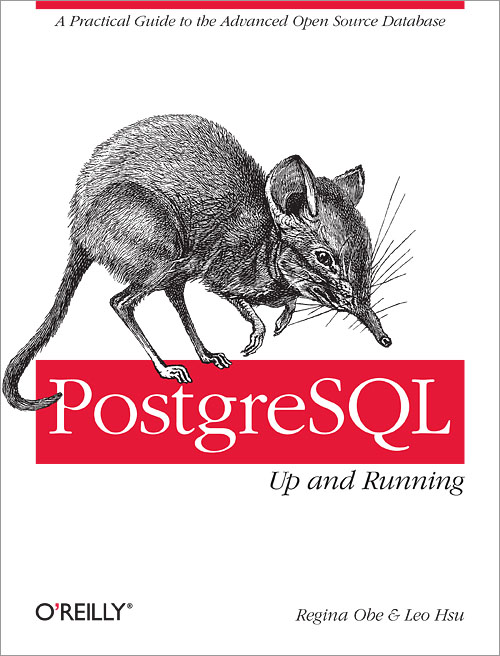
Our new book PostgreSQL: Up and Running is officially out. It's available in hard-copy and e-Book version directly from O'Reilly,
Safari Books Online and available from Amazon in Kindle store. It should be available in hard-copy within the next week or so from other distributors.
Sadly we won't be attending OSCON this year, but there are several PostgreSQL talks going on. If you are speaking at a talk or other PostgreSQL related get together, and would like
to give out some free coupons of our book or get a free e-book copy for yourself to see if it's worth effort mentioning, please send us an e-mail: lr at pcorp.us .
Our main focus in writing the book is demonstrating features that make PostgreSQL uniquely poised for newer kinds of workflows with particular focus on PostgreSQL 9.1 and 9.2.
Part of the reason for this focus is our roots and that we wanted to write a short book to get a feel for the audience. We started to use PostgreSQL in 2001 because of
PostGIS, but were still predominantly SQL Server programmers. At the time SQL Server did not have a spatial component that integrated seamlessly with SQL.
As die-hard SQLers, PostGIS really turned us on. As years went by, we began to use PostgreSQL
not just for our spatial apps, but predominantly non-spatial ones as well that had heavy reporting needs and that we had a choice of platform.
So we came for PostGIS but stayed because of all the other neat features PostgreSQL had that we found lacking in SQL Server. Three off the bat
are arrays, regular expressions, and choice of procedural languages. Most other books on the market just treat PostgreSQL like it's any other relational database.
In a sense that's good because it demonstrates
that using PostgreSQL does not require a steep learning curve if you've used another relational database. We didn't spend as much time on these common features as we'd like to
in the book because it's a short book and we figure most users familiar with relational databases
are quite knowledgeable of common features from other experience. It's true that a lot of people coming to PostgreSQL are looking for cost savings,
ACID compliance, cross-platform support and decent speed
, but as PostgreSQL increases in speed, ease of features, and unique features, we think we'll be seeing more people migrating
just because its simply better than any other databases
for the new kinds of workflows we are seeing today -- e.g. BigData analysis, integration with other datasources, leveraging of domain specific languages in a more seamless way with data.
So what's that creature on the cover?
It's an elephant shrew (sengi) and is neither an elephant nor a shrew, but closest in ancestry to the elephant, sea cow, and aardvark.
It is only found
in Africa (mostly East Africa around Kenya) and in zoos. It gets its name from its unusually long nose which it uses for sniffing out insect prey and keeping tabs on its mate. It has some other unusual habits:
it's a trail blazer building trails it uses to scout insect prey and also builds escape routes on the trail it memorizes to escape from predators. It's monogamous, but prefers to keep separate quarters from its mate. Males
will chase off other males and females will chase off other females. It's fast and can usually out-run its predators.
Tuesday, April 03. 2012
Printer Friendly
Yap that's right. PostGIS 2.0.0 is finally out the door. It took us Two years and 2 months, a super long incubation for us, but we did it and just in time for Javier's Where 2.0 2.0 Talk.. Paul has some border-line R rated pictures of the birthing process.
We have windows 32 binaries posted for those adventurous enough to taste the cookies while they are hot. We are working on the windows 64-bit binaries. Those should be out tomorrow. We'll be working in the coming week to get the installers ready to put up so they are available via Stack Builder. We'll probably put up the 32-bit ones first, hopefully followed shortly by the 64-bit ones. You should see PostGIS 2.0.0 soon on Yum as well. Devrim is cooking :).
Saturday, March 10. 2012
Printer Friendly
UPDATE We have PostGIS 2.0.0 available for both 32-bit and 64-bit windows PostgreSQL. We are wroking on getting the installers out
This past week has been very nerve racking but also exciting. We have successfully compiled PostGIS under the mingw64 chain and built a PostGIS windows 64-bit
for 2.0 (and 1.5), that can install under the Enterprise Db VC++ 64-bit builds of PostgreSQL 9.1. We haven't tried on 9.0, but we assume that should be fairly trivial.
Note only that, but it passes most of the PostGIS battery of tests. We first want to thank a group of people which made this all possible:
- Andrew Dunstan we are greatly indebted to for making it possible to compile PostgreSQL under mingw64 tool chain. As much as people have whined
about wanting to compile PostGIS under a pure VC chain, this is not possible at this juncture just because a lot of the tests and other tool chains PostGIS uses for building
are too tied to the Unix build environment.
- We want to thank the generous folks who provided money for our campaign so that we could funnel time from paid consulting work to focus on this effort and to prove that every little bit counts.
- SpatiaLite developer Alessandro Furieri whose mingw64 compile instructions were invaluable to helping us overcome our GEOS and other compile obstacles. SpatiaLite (the OGC spatial extender for SQLite),uses much of the same plumbing that PostGIS uses under the hood, so many of the lessons he learned an provide could be put to use with our problems.
- To Paul Ramsey especially and other PostGIS devs for general moral support and helping us tackle some PostGIS specific issues when compiled with mingw64. Paul demonstrated that yes you can mix VC++ built components with MingW and steps on how to do it. Part of the reason for that is the newer mingw32 seemed to crash with GEOS compiled under mingw32. Though the mingw64 chain didn't have this issue once we overcame our compile obstacle. We may in the future compare and see if compiling Geos under VC++ provides better performance and will also get us closer to having it possible to compile PostGIS fully under VC++ if people choose to. For the time being having a single tool chain that we can extract and run with is most important. We are preparing a self-standing Mingw64 tool chain with all the components needed to build PostGIS already compiled so that windows users who want to help with PostGIS need only extract to have a fully functioning postGIS dev environment and we also plan to move our mingw32 build to mingw64 chain of tools.
We hope to have a 64-bit compiled download ready next week for PostGIS 2.0.0 beta3 for people to try out. We are working on some issues with the raster2pgsql and loader/dumper guis we compiled not working right, but the core PostGIS works just fine in 64-bit and the 32-bit loader tools work fine against a 64-bit install. One thing we did notice with the 64-bit PostgreSQL is that we
can set shared_buffers much higher than the 32-bit PostgreSQL windows. On windows we could never go beyond ~700MB without it not being able to start or crashing. With the 64-bit we were able to go to 2GB. Haven't tried higher yet. We hope this will prove to be a performance boost for tasks such as geocoding that reuse a lot of the same datasets and benefit a lot from share memory.
Sunday, February 05. 2012
Printer Friendly
As many may have noticed, PostgresOnline.com has been down for the past week or so and probably is still not reachable from many parts of the world since our DNS server was also taken down as a result of a Distributed Denial of Service (DDOS) attack instigated by an Activision Call of Duty Game exploit that turned thousands of Call of Duty game servers into Zombies launching an attack on us.
We have a small confession to make. One of the businesses we co-own is an e-Commerce site that sells condoms. You never know how people will react when you say that in mixed company so we only mention it in closer company. Some people are glad we are in a business protecting against venereal diseases or unwanted pregnancies and some feel strongly we are violating a mother nature creed of conduct. WowCondoms was the site that was under attack on a UDP port and we are not sure if it was a malicious intent or not since the root instigator has not been found yet. The attack was higher up from our servers so it knocked our ISP who in turn blamed us for their outage. We never saw the traffic.
The tragic thing is that it can happen to any site and does all the time. It really hit home when it happened to us.
Details of our fight are described here: WowCondoms plugs hole in Activision's Call of Duty Game Servers
Wednesday, December 14. 2011
Printer Friendly
Two exciting things happened this past month.
- Our article on upcoming PostGIS 2.0 recently came out in GeoInformatics Magazine December 2011 Issue 8. Check it out here. Starts on page 30.
- We just got notice that our book proposal has been accepted and this time it's not about PostGIS.
Continue reading "GeoInformatics article and new book in the works"
Sunday, December 11. 2011
Printer Friendly
In our article The Pure Relational database is dead there
were a lot of misunderstandings as a result of our poor choice of words. People thought we were bashing the relational model because in their mind that was what
pure meant. I got hit with a lot of poetic insults. I still can't think of an alternative word to use for what I meant. Simple doesn't really do it as even relational databases with just standard types
were far from simple when you consider the planner and all the other stuff going on under the hood to protect you from the underlying storage structure. What I was trying to say is that in the beginning most relational databases
just supported a standard set of types which you could not expand on and most people when they think relational today still think just that. That type of relational database is in my book dead or almost dead.
How did this all start. Well whenever we use something like PostgreSQL to store anything complex -- take your pick: geometry data, tree like structures which we use
ltree for, full-text query constructs, and Yes XML we get bashed by some know-it-all who has a very narrow view of what a relational database should be doing and suggesting we use a NoSQL database, a graph engine or a full text engine or normalize our data more. I have also learned XML is a dirty word to many people. I mistakenly thought XML was a complex type people could
relate to, but turns out they can relate to it so well that it brings up tragic memories I can only equate to Post Traumatic Stress Disorder suffered by war veterans or (early or wrong) technology adopters. That was not
my intent either. XML was just merely an example. I will not say you should use XML in your tables, but I will also not say you should stay clear of it as many people wanted me to say. I will say its use is rare, but it has its place. It has its place just as any other complex type and it has its own special needs for navigation, indexing etc. which many relational databases handle fine enough.
Continue reading "The Relational Model is very much alive"
Saturday, December 03. 2011
Printer Friendly
A lot of redditers took offense at our article XPathing XML data with PostgreSQL
with the general consensus, if you are going to be stuffing XML in a relational database where will you stop? That is not what relational databases are designed for.
We had comitted a sacrilegious sin and worsed yet encouraging bad habits by forcing people to think more about different options they have for storing data in a relational database and god forbid demonstrating querying such columns with xml specific functions. What were we thinking? How dare we try to query XML data with SQL? Perhaps we were thinking like this guy or this guy,
both equally misguided spatial relational database folk.
Of course we stepped one foot further by actually defining a column as xml and dare storing data in it for later consumption rather than just an intermediary step.
If I want to store documents, that are navigateable I should be using a document database like MongoDb, CouchDB etc designed for that kind of stuff. If I've got graphs I should be using a graph database. This got me thinking
that the "Pure Relational Database" is dead, and I'm surprised most people don't seem to realize it.
So while "Relational databases" have changed over the last 25 years, most people's notions of them have not kept up with the pace of its change.
First let me define what I mean by Pure. A pure relational database is one with standard meat and potato types like text, dates, numbers well suited for counting money and computing how close the world is to total bankruptcy which you store as fields in a row of a table and that you then define foreign keys / constraints / primary keys on to relate them to other tables.
You reconstitute your real world objects by stitching these tables together with joins etc and return sets using where conditions, summarize by using group bys or other mathy like constructs. Don't get me wrong; these are very beautiful things because they allow for easy slicing of dimensions and not having to think about all the dimensions that make up an object all at once. In fact it was so beautiful that some people thought, "wow that's cool, but it would be even cooler if I could
store more complex objects in those columns with their own specific needs for querying." and so was born the object relational database as some people refer to them that thought relational but also understood that different types had their own unique needs for querying, storage, indexing etc.
Nowadays most, if not all, relational like databases have standardized on some variant of SQL.
In essence though, the pure relational database doesn't allow you to define new types or have exotic types such as arrays, xml, graphs, geometries, rasters, sparse matrices etc.
Much less thinking involved and less likely you will shoot yourself in the foot by dumping a bunch of xml in a field and trying to do something with it.
When it is used to store more complex things such as spreadsheets and other user documents, these are stored as blobs and just retrieved. Even such use is frowned upon.
Well most relational databases I can think of nowadays have richer types: e.g. PostgreSQL, Oracle and Firebird all support arrays as a column type. Some even allow you to define custom types and functions to support your custom types e.g. PostgreSQL (I could go on forever), Oracle has rich user defined type support too, and SQL Server 2005+ with each version getting better and better for user defined custom types and introducing more exotic types and support infrastructure. Even MySQL/Drizzle (mostly in the form of different storage engines). Even my favorite light-weight SQLite under the hood has some tricks that aren't what I would call relational. E.g. Spatialite/RasterLite has a whole geometry type library built on SQLite with functions you can call from SQL and I'm sure there are lots of middleware tools you don't know about
using the SQLite and Firebird engine for more than relational tasks (e.g. HTML5 anyone/ CAD anyone).
Friday, October 28. 2011
Printer Friendly
FOSS 4G 2011 Videos.
My resident PostGIS developer strk says he can't see them because blip.tv is using some sort of proprietary video swf format. I can't really tell what he is talking about. Does anyone know if fosslic videos are available in other formats like ogg or a Gnash swf viewer compatible format?
We mentioned in prior article Our FOSS4G 2011 the new Stuff and provided the slides in that article. Now we have the video to go with it.
Here is a partial list of PostGIS videos:
Continue reading "Many PostGIS FOSS4G 2011 videos have landed"
Friday, October 14. 2011
Printer Friendly
It is with sadness that I learned of the passing of Dennis Ritchie - inventor of C and who made much of Unix, other operating systems, and many software (including Postgres) possible.
More details at Remembering Dennis Ritchie: Software Pioneer
and Dennis Ritchie, in Memoriam.
Dennis Ritchie co-authored the book, The C Programming Language, a classic,
which many of my peers grew up with. It was one of the textbooks at MIT for Civil Engineering 1.00 when we were attending when the course was essentially an introduction to programming with C.
The harsh irony is that when Steve Jobs passed away I was probably the only one around me who
felt no remorse and hoped the curve fanaticism Jobs fueled would die with him. When Dennis Ritchie passed
away I was probably one of the few around me who knew who he was and appreciated the great contributions
he made to the computer industry.
|