Tuesday, May 10. 2011
Printer Friendly
Question: What is the difference between CURRENT_TIMESTAMP and clock_timestamp()
Answer: CURRENT_TIMESTAMP is an ANSI-SQL Standard variable you will find in many relational databases including PostgreSQL, SQL Server, Firebird, IBM DB2 and MySQL to name a few
that records the start of the transaction. The important thing to keep in mind about it is there is only one entry per transaction so if you have a long running transaction,
you won't be seeing it changing as you go along.
clock_timestamp() is a PostgreSQL function that always returns the current clock's timestamp. I don't think I'm alone in using it for doing simple benchmarking and other things
where for example I need to record the timings of each part of a function within the function using pedestrian RAISE NOTICE debug print statements.
There is another cool way I like using it, and that is for a batch of records each with an expensive function call, benchmarking how long it takes to process each record.
One of the things I'm working on is improving the speed of the tiger_geocoder packaged in PostGIS 2.0. The first root of attack seemed to me would be the normalize_address function
which I was noticing was taking anywhere from 10% to 50% of my time in the geocode process. That's a ton of time if you are trying to batch geocode a ton of records. The thing is
the function is very particular to how badly formed the address is so a whole batch could be held up by one bad apple and since the batch doesn't return until all are processed, it makes
the whole thing seem to take a while.
So rather than looping thru each, I thought it would be cool if I could run the batch, but for each record have it tell me how long it took to process relative to the rest so I could get
a sense of what a problem address looks like. So I wrote this query:
WITH ctbenchmark
AS
(SELECT  *,
        the_time - COALESCE(lag(the_time) OVER(ORDER BY the_time), CURRENT_TIMESTAMP)  As process_time,
            the_time - CURRENT_TIMESTAMP As diff_from_start
FROM (SELECT address_1, city, state, zip,
    pprint_addy(normalize_address(coalesce(address_1,'') || ', ' || coalesce(city || ' ','') || state || ' ' || zip)) As pp_addr,
        clock_timestamp() As the_time
       FROM testgeocode  LIMIT 1000) As foo )
SELECT *
FROM ctbenchmark
       WHERE process_time > '00:00:00.016'::interval;
Which returned an output something like this:
        address_1 |    city    | state |  zip   |     pp_addr  |          the_time          | process_time | diff_from_start
------------------+------------+-------+------- +-------------------------------------------+--------------+------------------
 48 MAIN ST ..    | S..        | MA    | 021..  | 48 MAIN ..   | 2011-05-10 03:24:43.078-04 | 00:00:00.032 | 00:00:00.032
 15 ...           |            | MA    | 018... | 15 GREN...   | 2011-05-10 03:24:50.796-04 | 00:00:00.031 | 00:00:07.75
Saturday, April 30. 2011
Printer Friendly
We like to enforce business rules at the database level wherever
we can, for the simple reason, particularly the business we are in, most database update happens
outside the end-user application layer.
That is not to say you shouldn't enforce at the application level too, but that the database is the last
line of defense, is usually more self-documenting than application code can be, and also protects you from your
programmers, even when that your programmers is you.
Domains are objects that you will find in many high-end
standards-compliant databases. They exist in SQL Server, Oracle, IBM Db2, Firebird, and PostgreSQL to name a few.
Domains have existed for a really long time in PostgreSQL. In PostGIS topology, Sandro Santilli (usually known as strk), takes advantage of them for fleshing out the topology support, and I got turned on to them by him.
With that said - let's dive into domains.
What are domains?
Domains are essentially a reusable packaging of check constraints. You use them as if they were a custom data type.
The nice thing about them is that they are usually transparent to applications that
don't understand them.
Example 1: Enforce pay ending/pay day happens only on certain days of the week
Here is an example -- suppose you had a payment system, and you had a rule that the pay thru end date has to
fall on a Friday. You could create a domain such as the following:
CREATE DOMAIN dom_payday
AS date
CONSTRAINT check_dow CHECK (trim(to_char(VALUE, 'day')) = 'friday');
COMMENT ON DOMAIN dom_payday IS 'Company payday rules';
Continue reading "Using Domains to Enforce Business Rules"
Friday, April 08. 2011
Printer Friendly
In a prior article Use of Out and InOut Parameters
we demonstrated how to use OUT parameters and INOUT parameters to return a set of records from a PostgreSQL function.
There is another approach to doing this, and that is to use the ANSI Standard RETURNS TABLE construct.
If you come from a SQL Server or IBM DB2 background, the RETURNS TABLE construct is probably most familiar, but still
how you use it and what is legal in it is a little different than it is in SQL Server or IBM DB2. We'll save the
contrast compare as a topic for another article.
In terms of performance between using OUT vs. RETURNS TABLE, we haven't noticed much of a difference. The main thing that is
nice about RETURNS TABLE is just that it's syntactically more pleasing in the sense that its clearer the structure of what you are returning.
In these next examples, we'll demonstrate similar examples we showed in the aforementioned article except using the
RETURNS TABLE.
Be warned that the RETURNS TABLE construct is only available for PostgreSQL 8.4+, while the OUT approach
has existed since PostgreSQL 8.1. With that said, if you need your code to work on 8.3 or lower, you can't use RETURNS TABLE.
When in doubt about a feature and you are creating code that needs to support earlier versions of PostgreSQL
(as we have to in the PostGIS development group),
or you want to get stubborn users off old antiquated versions of PostgreSQL and need a bit of ammunition
(as we have to (on PostGIS development including our own developers - and you know who you are :) ) )
check the
PostgreSQL feature matrix.
It will save you a lot of grief.
Continue reading "Using RETURNS TABLE vs. OUT parameters"
Wednesday, March 30. 2011
Printer Friendly
I am happy to report, that the final proof of the PostGIS in Action E-Book got released today
and the printed version is scheduled for release Aprill 11th, 2011 and should be available on Amazon and other locations around then. The other e-Reader formats will come after that.
You can buy from here or download the two free chapters, if you haven't already.
Each hard-copy purchase comes with a free E-Book version. There is a coupon in the back of the book when you get it to get the E-Book versions.
Yes, I know it's been a really really long time.
On the bright side, we produced twice as much content as we had set out to do and that was with keeping things as concise as we
could get away with, still managing to cover more than we set out to cover, and stripping out as many unnecessary words as we could muster.
So 520 pages and almost 2 years later, this is where we are.
A good chunk of the additional bulk of the book was the appendices which are about 150 pages
total and focus strictly on PostgreSQL and SQL. After many comments from early reviewers, we thought it unfair not to have a good chunk of PostgreSQL
and just general relational database content to familiarize programmers and GIS folks with the RDBMS that PostGIS lives in. Most GIS folk unfortunately
have the hardest time with getting up to speed with SQL and just standard RDBMS management.
Two free chapters and accompanying code for all chapters
The two free chapters we selectively picked because we thought they would be most beneficial to newcomers and people new to relational databases.
So the free chapters are:
- Chapter 1: What is a spatial database? Which provides a fast paced history of PostGIS, PostgreSQL, Spatial Databases and moves into
an even faster journey into converting flat file restaurant locations to spatial point geometries, loading in an ESRI shapefile of roads. Then shows you how to write standard
spatial queries and render the results.
- Appendix C: SQL Primer -- goes through querying information_schemas, the common points of writing SELECT, INSERT, UPDATE, DELETE SQL statements and the finer points of using aggregate functions, Windowing constructs and common table expressions as well
as a brief overview of how PostgreSQL stacks up with other relational databases (SQL Server, Oracle, IBM DB2, MySQL, Firebird) in SQL features.
- All the chapter code and accompanying data. It's a bit hefty at 57 MB.
So even if you don't buy our book, we hope you find the free chapters useful.
You can get a more detailed listing of all the chapters from the PostGIS in Action book site.
We'd like to thank all those who supported us through this long and unpredictable journey. Hopefully we'll have several more, though hopefully
a bit less nerve-racking than this first one.
Friday, February 25. 2011
Printer Friendly
Many of our customers ask us this question so we thought we'd lay down our thoughts.
The last couple of our articles have been how to do this and that in PostgreSQL, SQL Server, MySQL or having PostgreSQL coexist with an existing SQL Server install.
A major reason for that is that in many of our projects we have a choice of what database to choose for a new piece of an application as long as it can play nicely with the existing infrastructure.
Our core database competencies are still PostgreSQL, SQL Server, and MySQL with it leaning
more toward PostgreSQL each day. We are perhaps somewhat unique in the PostgreSQL community in that Oracle never comes into our equation of decisions (though Oracle and PostgreSQL are perhaps more similar than the others).
Oracle is too expensive for most of our clientele
so it's a non-issue, and when our clients do have Oracle -- it's thrust upon them by thier ERP/CRM vendor and is essentially off limits to them.
Continue reading "Why choose or not choose PostgreSQL?"
Monday, February 21. 2011
Printer Friendly
We were setting up another SQL Server 2005 64-bit where we needed a linked server connection to our PostgreSQL 9.0 server. This is something we've done before so not new and something we documented in
Setting up PostgreSQL as a Linked Server in Microsoft SQL Server 64-bit.
What was different this time is that we decided to use the latest version of the new PostgreSQL 64-bit drivers now available main PostgreSQL site http://www.postgresql.org/ftp/odbc/versions/msi/.
Sadly these did not work for us. They seemed to work fine in our MS Access 2010 64-bit install, but when used via SQL Server, SQL Server would choke with a message:
Msg 7350, Level 16, State 2, Line 1
Cannot get the column information from OLE DB provider "MSDASQL"
If you tried to do a query with them. You can however see all the tables via the linked server tab.
Continue reading "SQL Server 64-bit Linked Server woes"
Saturday, February 19. 2011
Printer Friendly
QuestionYou have a system of products and categories and you want a product to be allowed to be in multiple categories, but you want a product to only be allowed to be in one main category.
How do you enforce this rule in the database?
Some people will say -- why can't you just deal with this in your application logic. Our general reason is that much of our updating doesn't happen at our application level. We like enforcing rules at the database
level because it saves us from ourselves. We are in the business of massaging data. For this particular kind of example we wanted to make sure the database would provide us a nice safety net so that
we wouldn't accidentally assign a product in two main categories.
Answer
There are two approaches we thought of. One is the obvious have a primary category column and a bridge table that has secondary categories. That is an ugly solution because when you do a query you have to do a union
and always treat the secondary categories as different from the main. For most use-cases we don't usually care about distinguisihing primary from secondary category.
The solution we finally settled on was to have one bridge table with a boolean field for if its the main category. We enforce the only one main category requirement using a partial index. Now not all databases support partial indexes
This is one major value of using PostgreSQL that you have so many more options for implementing logic.
As some people noted in the comments and the reddit entry. SQL Server 2008 has a similar feature called Filtered Indexes. Though PostgreSQL has had partial indexes for as far back as I can remember. This brings up an interesting point which I have observed -- if you were using PostgreSQL before, you would already know how to use the Filtered Indexes, Multi row inserts introduced in SQL Server 2008, and the SEQUENCES feature coming in SQL Server 2010. So we should all use PostgreSQL, because it teaches us how to use the newer versions of SQL Server before they come out. :)
So how does the partial index solution look: NOTE for simplicity, we are leaving out all the complimentary tables and the foreign key constraints that we also have in place.
CREATE TABLE products_categories
(
  category_id integer NOT NULL,
  product_id integer NOT NULL,
  main boolean NOT NULL DEFAULT false,
  orderby integer NOT NULL DEFAULT 0,
  CONSTRAINT products_categories_pkey PRIMARY KEY (category_id, product_id)
);

CREATE UNIQUE INDEX idx_products_categories_primary
  ON products_categories
  USING btree
  (product_id)
  WHERE main = true;
Testing it out. It saves us and gives us a nice informative message to boot.
INSERT INTO products_categories(category_id, product_id, main)
VALUES (1,2,true), (3,2,false), (3,3,true), (4,2,true);
ERROR: duplicate key value violates unique constraint "idx_products_categories_primary"
DETAIL: Key (product_id)=(2) already exists.
Tuesday, January 18. 2011
Printer Friendly
In our last article we talked about String Aggregation implementing in PostgreSQL, SQL Server, and MySQL. This task is one that makes purist relational database programmers
a bit squeamish. In this article we'll talk about the reverse of that, how do you deal with data that someone hands you delimeted in a single field and that you are asked to explode or re-sort based on some lookup table.
What are the benefits of having a structure such as? : p_name | activities
--------+--------------------------------
Dopey | Tumbling
Humpty | Cracking;Seating;Tumbling
Jack | Fishing;Hiking;Skiing
Jill | Bear Hunting;Hiking
Well for the casual programmer or simple text file database that knows nothing about JOINS and so forth, it makes it simple to pull a list of people who like Tumbling.
You simply do a WHERE ';' || activities || ';' LIKE '%;Tumbling;%'. It's great for security too because you can determine security with a simple like check and also list all the security groups a member belongs in without doing anything.
Quite easy for even the least data-skilled of programmers to work with because most procedural languages have a split function that can easily parse these into an array useful for stuffing into drop down lists and so forth. As a consultant of semi-techie people
I'm often torn by the dilemma of "What is the way I would program for myself vs. the way that provides the most autonomy to the client". By that I mean
for example I try to avoid heavy-weight things like Wizards that add additional bloated dependencies or slow the speed down of an application. These bloated dependencies may provide ease to the client but make my debugging life harder. So I weight the options
and figure out which way works now and also provides me an easy escape route should things like speed or complexity become more of an issue.
This brings us to the topic of, what is wrong with this model? It can be slow because the LIKE condition you have can't easily take advantage of an index unless using a full text index so not ideal where this is the primary filtering factor. It's also prone to pollution because
you can't easily validate that the values in the field are in your valid set of lookups or if your lookup changes, the text can be forced to change with a CASCADE UPDATE/DELETE RULE etc. In cases where this is of minor consequence
which is many if referential integrity is not high on your list of requirements, this design is not bad. It might make a purist throw up but oh well there is always dramamine to fall back on. As long as you have done your cost benefit analysis, I don't think there should be any shame of following this
less than respected route.
While you may despise this model, it has its place and it's a fact of life that one day someone will hand it to you and you may need to flip it around a bit. We shall demonstrate how to do that in this article.
Continue reading "Reverse String Aggregation: Explode concatenated data into separate rows In PostgreSQL, SQL Server and MySQL"
Friday, December 24. 2010
Printer Friendly
Question: You have a table of people and a table that specifies the activities each person is involved
in. You want to return a result that has one record per person and a column that has a listing of activities for each person
separated by semicolons and alphabetically sorted by activity. You also want the whole set alphabetically sorted by person's name.
This is a question we are always asked and since we mentor on various flavors of databases,
we need to be able to switch gears and provide an answer that works on the client's database. Most
often the additional requirement is that you can't install new functions in the database. This means that
for PostgreSQL/SQL Server that both support defining custom aggregates, that is out as an option.
Normally we try to come up with an answer that works in most databases, but sadly the only solution that works in
most is to push the problem off to the client front end and throw up your hands and proclaim -- "This ain't something that should be
done in the database and is a reporting problem." That is in fact what many database purists do, and all I can say to them is wake up and smell the coffee before you are out of a job.
We feel that data
transformation is an important function of a database, and if your database is incapable of massaging the data into a format
your various client apps can easily digest, WELL THAT's A PROBLEM.
We shall now document this answer rather than trying to answer for the nteenth time. For starter's
PostgreSQL has a lot of answers to this question, probably more so than any other, though some are easier to execute than others
and many depend on the version of PostgreSQL you are using. SQL Server has 2 classes of answers neither of which is terribly appealing,
but we'll go over the ones that don't require you to be able to install .NET stored functions in your database since we said that is often a requirement.
MySQL has a fairly
simple, elegant and very portable way that it has had for a really long time.
Continue reading "String Aggregation in PostgreSQL, SQL Server, and MySQL"
Sunday, November 14. 2010
Printer Friendly
Many people have been concerned with Oracle's stewardship of past Sun Microsystems open source projects.
There are Java, MySQL, OpenSolaris to name a few.
Why are people concerned? Perhaps the abandoning of projects such as OpenSolaris, the suing of Google over Java infringements, the marshalling out of many frontline contributors of core Open Source projects from Oracle, the idea of forking over license rights to a single company so they can relicense your code.
We have no idea.
All we know is that there is an awful lot of forking going on.
To Oracle's defense, many do feel that they have done a good job with progressing the advancements of some of the Open Source projects they have shepherded.
For example getting MySQL patches more quickly in place etc. For some projects where there is not much of a monetary incentive, many feel they have at best neglected e.g. OpenSolaris.
Perhaps it's more Oracle's size and the size that Sun was before takeover that has made people take notice that no Open Source project
is in stable hands when its ecosystem is predominantly controlled by the whims of one big gorilla.
One new fork we were quite interested to hear about is LibreOffice, which is a fork of OpenOffice.
In addition to the fork, there is a new organization
called Document Foundation to cradle the new project. Document Foundation is backed by many OpenOffice developers and corporate entities (Google, Novell,Canonical) to name a few.
The Document Foundation mission statement is outlined here. There is even a document foundation planet for LibreOfficerians to call home.
The LibreOffice starter screen looks similar to the OpenOffice starter screen, 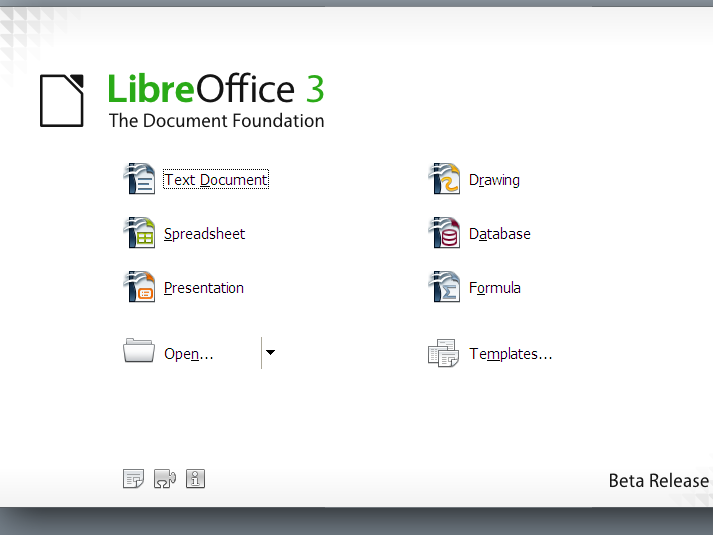 except instead of the flashy Oracle logo we have come to love and fear, it has a simple text Document Foundation below the basic multi-colored Libre Office title. Much the same tools
found in OpenOffice are present. The project has not forked too much in a user-centric way from its OpenOffice ancestor yet. The main changes so far are the promise of not having to hand over license assignment rights to a single company as described in
LibreOffice - A fresh page for OpenOffice as well as some general cleanup and introduction of plugins that had copy assignment issues such as some from RedHat and Go-OO. My favorite quote
listed in the above article is It feels like Oracle is "a mother who loves her child but is not aware that her child wants to walk alone." by André Schnabel. So perhaps Oracle's greatest contribution and legacy to Open Source and perhaps the biggest that any for-profit company
can make for an Open Source project is to force its offspring to grow feet to walk away. except instead of the flashy Oracle logo we have come to love and fear, it has a simple text Document Foundation below the basic multi-colored Libre Office title. Much the same tools
found in OpenOffice are present. The project has not forked too much in a user-centric way from its OpenOffice ancestor yet. The main changes so far are the promise of not having to hand over license assignment rights to a single company as described in
LibreOffice - A fresh page for OpenOffice as well as some general cleanup and introduction of plugins that had copy assignment issues such as some from RedHat and Go-OO. My favorite quote
listed in the above article is It feels like Oracle is "a mother who loves her child but is not aware that her child wants to walk alone." by André Schnabel. So perhaps Oracle's greatest contribution and legacy to Open Source and perhaps the biggest that any for-profit company
can make for an Open Source project is to force its offspring to grow feet to walk away.
In later posts we'll test drive Libreoffice with PostgreSQL to see how it compares to its OO ancestor and what additional surprises it has in store.
Though in future if Oracle does donate the trademark Openoffice name to the foundation, then
LibreOffice may go back to being called OpenOffice. Personally I like LibreOffice better and the fact that the name change signals a change in governance.
Friday, November 05. 2010
Printer Friendly
Problem: You have a set of numbers, or characters or whatever and you are trying to find the max or min of this set?
If the values are separate records in a table or query, the answer is well known and respected across all relational databases -- use the aggregate MAX and MIN functions.
But what if you have a set of free wheeling numbers or text not in separate records, and you want the max or min of each. Here is where the
least and greatest functions come in handy.
PostgreSQL has had these functions for as far back as I can remember and is not the only database to sport these marvelous functions. Our beloved MySQL and Oracle database have these functions as well. Sadly our more beloved SQL Server even in the SQL Server 2008
variant - lacks these functions.
Okay how to use these functions -- you use it like this:
    SELECT least(1,-2,5) As num_least, greatest('Bobby', 'Catty', 'Kitty') As greatest_cat;

    Yields:
 num_least| greatest_cat
----------+----------
       -2 | Kitty
We would classify these functions along the lines of COALESCE. They are like COALESCE because they take an arbitrary number of arguments and the datatype that is returned
is highest datatype that all arguments in the function can be autocast to. If there is no autocast then well you get an error. To demonstrate, guess what happens when you do this:
SELECT least(-1, 'Kitty');
Well do this in PostgreSQL at least in 8.3+, you get a nice slap if you haven't installed any deprecated autocasts:
ERROR: invalid input syntax for integer: "Kitty"
LINE 1: SELECT least('Kitty', -1)
Do this in MySQL - so friendly and forgiving, and great reader of minds and you get:
-1
OF COURSE
I apologize for the ambiguous sarcasm, its just sometimes I want my mind read and sometimes I don't and I just can't figure out whether today is one of those days or the other day.
Friday, October 29. 2010
Printer Friendly
pgAdmin has this feature called a pgScript. Its a very simple scripting language for running
tasks in a pgAdmin SQL window. The documentation is PgScript manual.
Why would you use it over say writing a plpgsql function?
One main reason we use it is to run quick ad-hoc batch jobs such as geocoding addresses and so forth. The
benefit it has over running a stored function is that you don't have to run it as a single transaction.
This is important for certain kinds of tasks where you just want to run something in a loop and have each loop commit
separately. To us the syntax with the @ resembles SQL Server Transact-SQL more than it does any PostgreSQL language. WhenI first
saw pgScript I thought Wow PgAdmin talks Transact-SQL; now -- what will they think of next :).
Continue reading "pgAdmin pgScript"
Monday, October 11. 2010
Printer Friendly
One of the neat changes already present in the PgAdmin III 1.13dev, is the change in plugin architecture. Version 1.13 dev allows for multiple plugin*.ini files. How does this work.
Well if you have a plugins.d folder in your PgAdmin III version folder, it will read all the inis in that folder and load them as plugins.
Recall in PgAdmin III Plug-in Registration: PostGIS Shapefile and DBF Loader,
we demonstrated how to load the PostGIS shapefile and dbf loader as a plugin in PgAdmin III, well this time we will demonstrate how to do it using PgAdmin version 1.13. Better yet, we'll show you the new and improved
PgAdmin III Shapefile and DBF Loader in the works for PostGIS 2.0.
Continue reading "PgAdmin III 1.13 - change in plugin architecture and PostGIS Plugins"
Thursday, October 07. 2010
Printer Friendly
Universal Unique Identifiers are 16-byte / 32-hexadecimal digit (with 4 -s for separation)
identifiers standardized by the Open Software Foundation.
The main use as far as databases go is to ensure uniqueness of keys across databases. This is important if you have multiple servers or disperate systems that need to replicate or share
data and each can generate data on its own end. You want some non-centralized mechanism to ensure the ids generated from each server will never overlap.
There are various open standards
for generating these ids and each standard will tie the id based on some unique identifier of the computer or a namespace or just a purely random generator algorithm not tied to anything.
Since this is a question often asked by users coming from Microsoft SQL Server, we will demonstrate in this article the same concept in Microsoft SQL Server and how you would achieve similar functionality in PostgreSQL.
Continue reading "Universal Unique Identifiers PostgreSQL SQL Server Compare"
Sunday, August 22. 2010
Printer Friendly
PostgreSQL offers several options for displaying and querying tree like structures.
In Using Recursive Common Table Expressions (CTE) to represent tree structures
we demonstrated how to use common table expressions to display a tree like structure. Common Table Expressions required PostgreSQL 8.4 and above but was fairly ANSI standards compliant. In addition to that
approach you have the option of using recursive functions. There is yet another common approach for this which is specific to PostgreSQL. This is using the ltree contrib datatype
that has been supported for sometime in PostgreSQL. For one of our recent projects, we chose ltree over the other approaches because the performance is much better when you need to do ad-hoc queries over the tree since it can take advantage of btree and gist indexes
and also has built-in tree query expressions that make ad-hoc queries simpler to do; similar in concept to the tsearch query syntax for querying text.
In this article we'll demonstrate how to use ltree and along the way also show the PostgreSQL 9.0 new features conditional triggers and ordered aggregates.
Continue reading "Using LTree to Represent and Query Hierarchy and Tree Structures"
|